
Short Overview |
edit overview |
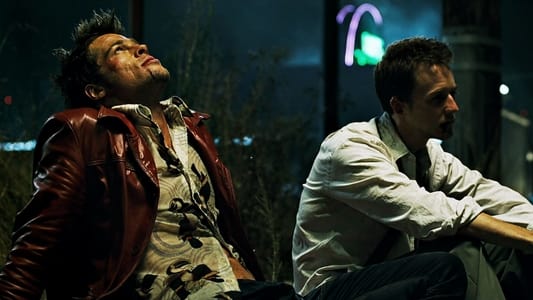
A lonely, isolated thirty-something young professional seeks an escape from his mundane existence with the help of a devious soap salesman. They find their release from the prison of reality through underground fight clubs, where men can be what the world now denies them. Their boxing matches and harmless pranks soon lead to an out-of-control spiral towards oblivion.
-
Edward Norton
as Narrator -
Brad Pitt
as Tyler Durden -
Helena Bonham Carter
as Marla Singer -
Meat Loaf
as Robert 'Bob' Paulson
Wiki |
edit article |
Fight Club is a 1999 American feature film adaptation of the 1996 novel of the same name by Chuck Palahniuk. The film, directed by David Fincher, follows a nameless protagonist (Edward Norton), an everyman and an unreliable narrator who feels trapped with his white-collar position in society. The narrator gets involved in a fight club with soap salesman Tyler Durden (Brad Pitt) and becomes tangled up in a relationship triangle with Durden and a destitute woman, Marla Singer (Helena Bonham Carter).
Palahniuk’s novel was optioned by producer Laura Ziskin, who hired Jim Uhls to write the script for the film. Several directors were sought to film Fight Club; David Fincher was hired to direct based on his interest in the project despite previous difficulties with the studio 20th Century Fox. Fincher worked with Uhls to develop the script, seeking advice from others in the film industry and his own cast members. Fincher described Fight Club as black comedy that applies heavy satire; he and the cast also compared the film to The Graduate (1967) and Rebel Without a Cause (1955). Thematically, the film was intended to represent the conflict between a generation of young people and the value system of advertising. The film’s use of violence in the fight clubs was intended to serve as a metaphor for feeling based on the generation’s conflict. The director carried homoerotic overtones over from Palahniuk’s novel to implement in the film, believing that the overtones would make audiences uncomfortable and thereby keep them from anticipating the twist ending.
Studio executives were not receptive to the film, and they altered Fincher’s intended marketing campaign to try to recoup perceived losses. Fight Club failed to meet expectations at the box office, and the film received polarized reactions from film critics. The film was cited as one of the most controversial and talked-about films of 1999. It was perceived as crossing a milestone for visual style in cinema and introducing a new mood in American political life. The film later found commercial success with its DVD release, which established Fight Club as a cult film. The film has also permeated American society, inspiring people to set up fight clubs.
Development
In 1996, a 20th Century Fox book scout sent a galley proof of Chuck Palahniuk’s novel Fight Club to creative executive Kevin McCormick. Despite a studio reader discouraging a film adaptation of the material, McCormick passed the proof on to producers Lawrence Bender and Art Linson, who in turn also rejected it. Producers Josh Donen and Ross Bell then expressed interest in the project and arranged unpaid screen readings with actors, initially lasting six hours, to determine the length of a script. After cutting out sections to reduce the running time and recording the dialogue, Bell sent the book on tape to Laura Ziskin, head of the division Fox 2000, who after listening to the tape purchased the rights to Fight Club for $10,000.
To adapt the story into a screenplay, Ziskin initially considered hiring Buck Henry; Ziskin thought that Fight Club was similar to The Graduate, which had been adapted by Henry. However, a new screenwriter, Jim Uhls, began lobbying Donen and Bell to be hired to adapt the screenplay and was subsequently chosen by the producers over Henry. For directing, Bell had four options in mind: Peter Jackson, Bryan Singer, Danny Boyle, and David Fincher. Bell considered Jackson the best choice and contacted the director, but Jackson was too busy filming The Frighteners (1996) in New Zealand. Singer received the book, but did not read it, while Boyle met with Bell and read the book, he ultimately pursued another project. Fincher, who had previously read the book and tried to buy the rights himself, talked with Ziskin about directing the film, but was hesitant to work with 20th Century Fox again after his bad experiences with the studio during Alien³ (1992). A meeting with Ziskin and studio head Bill Mechanic restored his relationship with the studio, and in August 1997, 20th Century Fox announced that Fincher would helm the film adaptation of the novel. Mechanic and Ziskin initially planned to finance the film with a $23 million budget.