
Inglourious Basterds

DE, US 


Short Overview

edit overview

In Nazi-occupied France during World War II, a group of Jewish-American soldiers known as "The Basterds" are chosen specifically to spread fear throughout the Third Reich by scalping and brutally killing Nazis. The Basterds soon cross paths with a French-Jewish teenage girl who runs a movie theater in Paris which is targeted by the soldiers.

Wiki

edit article

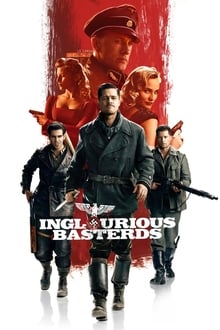
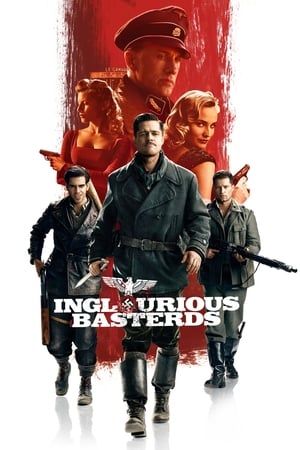
Inglourious Basterds is a 2009 war film written and directed by Quentin Tarantino and released in August 2009 by The Weinstein Company and Universal Pictures. It was filmed in several locations, among them Germany and France, beginning in October 2008. The film, set in German-occupied France, tells the story of two plots to assassinate the Nazi political leadership, one planned by a young French Jewish cinema proprietress, the other by a team of American soldiers called the “Basterds”.

Tarantino has said that despite it being a war film, Inglourious Basterds is a “spaghetti western but with World War II iconography”. In addition to spaghetti westerns, the film also pays homage to the World War II “macaroni combat” sub-genre (itself heavily influenced by spaghetti-westerns).

Inglourious Basterds was accepted into the main selection at the 62nd Cannes Film Festival in competition for the prestigious Palme d’Or and had its world premiere there in May. It was the only U.S. film to win an award at Cannes that year, earning a Best Actor award for Christoph Waltz.

Title

The title of the film was inspired by director Enzo Castellari’s 1978 Dirty Dozen-like war film The Inglorious Bastards. Though Tarantino acknowledges that both the former and the latter were inspirations for the film, and there are noticeable similarities, he stresses that Basterds is an original work and not a remake of the 1978 film. To date, there has been little explanation of the title spelling (the correct spelling would be “Inglorious Bastards”). When asked, Tarantino would not explain the u in Inglourious and said, “But the ‘Basterds’? That’s just the way you say it: Basterds.” He stated in an interview that the misspelled title is “a Basquiat-esque touch.” He further commented on The Late Show with David Letterman that “Inglourious Basterds” is the “Tarantino way of spelling it.”

Development

Quentin Tarantino spent more than a decade writing the script because, as he told Charlie Rose in an interview, he became “too precious about the page,” meaning the story kept growing and expanding. Tarantino viewed the script as his ultimate masterpiece in the making, so he felt it had to become the best thing he’d ever written. Tarantino described an early premise in October 2001: “[It’s] my bunch-of-guys-on-a-mission film. [It’s] my Dirty Dozen or Where Eagles Dare or Guns of Navarone kind of thing.” The premise had begun as a Western and evolved into a World War II version of The Good, the Bad and the Ugly set in German-occupied France. The story changed to be about two maverick units from the United States Army that had “a habit of scalping Germans”.

According to Tarantino, a recurring hallmark in all his movies, including ‘Inglourious Basterds’, is that there is a different sense of humour in all his movies, which gets the audience to laugh at things that aren′t funny.

Actor Michael Madsen, who appeared in Tarantino’s Reservoir Dogs and Kill Bill, was originally reported to star in the movie, then spelled Inglorious Bastards, which had been scheduled for release in 2004. Tarantino has also talked to German actress Nastassja Kinski for the role of Bridget Von Hammersmark and flew to Germany to meet the actress but a deal was not reached. By 2002, Tarantino found Inglourious Basterds to be a bigger film than planned and saw that other directors were working on World War II films. By this point, he had produced three nearly finished scripts, saying, “[It was] some of the best writing I’ve ever done. But I couldn’t come up with an ending.” Consequently, the director held off his planned film and moved on to direct the two-part movie Kill Bill (2003–2004) with Uma Thurman in the lead role.

After the completion of Kill Bill, Tarantino trimmed the length of the script, which was reportedly three films long, to 222 pages, and planned to begin production of Inglourious Basterds late in 2005. The revised premise focused on a group of soldiers who escape from their executions and embark on a mission to help the Allies. He described the men as “not your normal hero types that are thrown into a big deal in the Second World War”. He continued to describe the film as a spaghetti western set in German-occupied France, specifically around the time of D-Day (June 6, 1944) and afterward.

In November 2004, Tarantino decided to hold off production of Inglourious Basterds and instead film a kung fu movie entirely in Mandarin. This project floundered too, and he ultimately directed a part of the 2007 Grindhouse instead, returning to work on what was now renamed Inglourious Basterds after finishing promotion for Grindhouse.

Production

Tarantino teamed with The Weinstein Company to prepare what he planned to be his epic masterpiece for production. In September 2007, The Irish Times reported the film’s scheduled release for 2008, writing, “Inglourious Basterds, a war movie that may eventually resemble The Dirty Dozen merged with Cross of Iron, has been predicted more often than the second coming of the Lord.”

In July 2008, Tarantino and the Weinsteins set up an accelerated production schedule to be completed for release at the Cannes Film Festival in 2009. The Weinstein Company co-financed the film and distributed it in the United States. The company signed a deal with Universal Pictures to finance the rest of the film and distribute it internationally. Germany and France were scheduled as filming locations. Filming was scheduled to begin on October 13, 2008, and shooting started that week. Special Effects were handled by K.N.B. EFX Group with Greg Nicotero. Much of the film was shot and edited primarily in the famous Babelsberg Studios in Potsdam, Germany, the oldest large-scale film studio in the world, and in Bad Schandau, a small village near the German border with the Czech Republic.

Following the film’s screening at Cannes, Tarantino stated that he would be re-editing the film in June before its ultimate theatrical release, allowing him time to finish assembling several scenes that weren’t completed in time for the hurried Cannes premiere.

Censorship

Universal Pictures censored the film’s German publicity site, as the display of Nazi iconography is mostly illegal in Germany. The title has the swastika removed and the Stahlhelm (Steel Helmet) has a bullet hole instead of the Nazi symbol. The download section of the German site has been revised to exclude wallpaper downloads that feature the swastika openly. Though the advertisement posters and wallpapers must not show Nazi iconography, this does not apply to “works of art” according to German law, so the movie itself is not censored in Germany. Nazi iconography such as swastikas and the Runic letters of the SS logo were also removed from posters for the film in the UK, although magazine advertisements with the same layout retained them.

Soundtrack

One of the more familiar tunes is the opening theme, taken from the folk ballad “The Green Leaves of Summer”, composed by Dimitri Tiomkin and Paul Francis Webster for the opening of John Wayne’s movie “The Alamo” (1960). As is usual for a Quentin Tarantino film, the music used in the film is eclectic, but mostly consisting of music in the spaghetti-western genre. The soundtrack was released on August 18, 2009.

Tarantino originally wanted Ennio Morricone to compose the soundtrack for the film. Morricone was unable to because of the sped-up production schedule of the film conflicted with his scoring of the Giuseppe Tornatore feature Baarìa. However, Tarantino did use several tracks by Morricone from previous films in the soundtrack.

Similar

 
vote
(24 votes) 8.38
edit Help

Movie Facts

Status:
Released on the 2009-08-21
Runtime:
153 Minutes
Budget:
$70,000,000
Revenue:
$319,131,050
Languages (original):
German, English, French, Italian
Production Companies:
Official Homepage:
edit Help

Trailers (english)

add Help

Categories

add Help

Plot Keywords

add Help

References

 There are no references.
edit Help

Alternative Titles

English

  • Sort
    Bastardi Senza Gloria
  • Sort
    Inglorious Bastards
  • Sort
    Malditos Bastardos
Movie created by:
Movie last edited by:
81.67.253.46
Help

Embed Movie Information

trackback url Help

Trackbacks